The School District of Whitefish Bay is engaged in a Facilities Long Range Planning process, with support from Plunkett Raysich Architects and CD Smith. Information and updates related to the process will be included on this page as they become available. On September 18, 2024, the School Board approved the Facilities Charter, a document that will guide the facilities planning process. The Charter was created based on input from the Board, as well as the Facilities Subcommittee.
Whitefish Bay public schools have a strong tradition of excellence; we are proud to be among the highest achieving districts in Wisconsin. While we address routine maintenance each year, all five buildings (built between 1918 and 1955) are aging. Building systems (such as HVAC, plumbing, and electrical) have exceeded their service life, and classrooms/support areas do not meet today’s standards, including accessibility challenges.
Funding Development Timeline
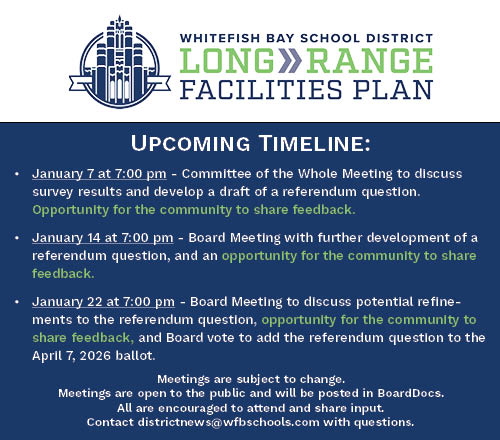
Save the Dates! The School Board for the School District of Whitefish Bay invites you to attend upcoming meetings to share feedback on a potential referendum question. ⏰ Wednesday, January 7 at 7:00 pm in the High School Library Media Center – Committee of the Whole Meeting to discuss survey results and develop a draft of a referendum question. Opportunity for community to share feedback. ⏰ Wednesday, January 14 at 7:00 pm in the High School Library Media Center – Board meeting with further development of a referendum question, and an opportunity for community to share feedback. ⏰ Thursday, January 22 at 7:00 pm in the High School Library Media Center – Board meeting to discuss potential refinements to the referendum question, opportunity for community to share feedback, and Board vote to add the referendum question to the April 7, 2026 ballot.
Meetings are subject to change. Meetings are open to the public and will be posted in BoardDocs. All are encouraged to attend and share input. Contact districtnews@wfbschools.com with questions.
Thank you to all those who shared their input by taking the Facilities Survey!
The window to complete the survey was November 1 through November 20. Community presentations were held at each district building, prior to the survey deadline. The same information was shared at each session.
Whitefish Bay public schools have a strong tradition of excellence; we are proud to be among the highest achieving districts in Wisconsin. While we address routine maintenance each year, all five buildings (built between 1918 and 1955) are aging. Building systems (such as HVAC, plumbing, and electrical) have exceeded their service life, and classrooms/support areas do not meet today’s standards, including accessibility challenges.
Most Pressing Needs:
Infrastructure, Safety, & Security
The facility study identified critical infrastructure needs at the following schools: High School ($35.5 million), Cumberland and Richards (totaling $20.3 million), and Lydell ($2.4 million). Many building systems are original (some nearly 100 years old) and are beyond their useful life.
Estimated Cost: $58.2 M
Middle School
Given its age, layout, and inflexible design, the cost to renovate the current Middle School is approximately the same as a new building.
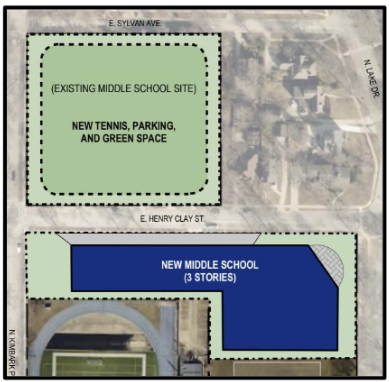
As a result, the School Board is recommending building a new middle school on the south side of Henry Clay Street. The Veterans' Memorial Monument would be re-established on or near its current site, and the tennis courts and parking lot would be relocated. This option provides the best long-term investment in facilities, avoids disruption to teaching and learning, and offers the most design flexibility.
Estimated Cost: $67.7 M
Key Documents:
The Board, District, and Facilities Advisory Committee (FAC) are excited to share their work and how the District has arrived at this point in the process. If you only have a short amount of time to learn about the facilities planning process, please review the key documents below by clicking on each button. If you have a bit more time, we encourage you to take a deep dive into all of the resources linked on this page. Please reach out to a committee member if you have any questions that come up. Thank you for your engagement!
In-Depth Learning Topics:
Facilities Presentations & Progress Updates (Click to Expand)
What is Whitefish Bay School District’s Facilities Long-Range Planning process? (An Overview)
Whitefish Bay School District’s facilities long range planning effort was developed through collaboration between the School Board, district leaders, and our community. This work builds on our District Focus Plan and reflects our shared commitment to supporting student learning, strong governance, and responsible stewardship of resources.
The purpose of the facilities long range planning process is to look ahead over the next 20 years to ensure that our schools remain safe, sustainable, and well-suited to the evolving needs of students, staff, and the community. This includes addressing ongoing maintenance, planning for future enrollment, and aligning our facilities with the high expectations our community holds for educational excellence.
Through this process, we will bring forward recommendations and seek input from families, staff, and community members. The feedback gathered from the community survey will help us determine the best path forward so that our facilities continue to support the exceptional teaching and learning that define the Whitefish Bay School District.
What planning has been done up to this point?
The Facilities Planning process began in June 2023, which was also supported by the Community Conversation strategic planning event themes in November 2023. The School Board approved the Facilities Charter in September 2024 to provide a charge for the planning process. The Facilities Subcommittee, Facilities Advisory Committee, and the School Board participated in an extensive planning process to identify facilities needs across the District.
What has been learned through this process and from facilities and long-range planning?
The Facilities Advisory Committee (FAC) is a group of nearly twenty school community members, including family members, recreation participants, staff, and students. The committee spent 8 months meeting and learning about District needs related to facilities plan development with the goal of providing a recommended plan to the Board of Education.
What needs did the facilities planning process identify?
The Facilities Charter outlined four priority areas for the facilities planning process, which were the focus of the FAC. The priority areas are as follows:
Learning Spaces: Ensuring classrooms support modern teaching methods and collaboration.
Infrastructure: Addressing aging systems like plumbing, HVAC, and electrical.
Health, Safety & Security: Creating secure, accessible, and safe environments for everyone.
Sustainability: Improving energy efficiency to reduce long-term costs and environmental impact.
The committee's in-depth review, including tours and a comprehensive facility assessment, has helped to determine the full scope of needs and priorities.
What other options were considered for updating the Middle School?
Due to the landlocked nature of Whitefish Bay, there are limited options for updating District buildings. Most potential options involved updating buildings on their current sites, with the possibility for increasing square footage with additions. Still, space available for expansion is very limited and would reduce outdoor areas for playgrounds, athletic fields, and parking.
Based on the challenges presented with the current Middle School, several options for remodeling or relocating the building were considered, including:
New Middle School on the Lydell site (too small of a footprint, loss of shared amenities with the High School, transportation challenges)
New Middle School on Armory (Lacrosse) Field (cannot replace field elsewhere; largest greenspace available)
New Middle School attached to the High School (traffic, parking, and logistical issues; challenges in relocating softball field)
New Middle School bridging over Henry Clay Street (height of bridge needed for traffic is impractical)
New Middle School built over Henry Clay Street by closing the street (re-routing traffic would create challenges)
Rebuild the Middle School in its current location (multi-year disruption to teaching and learning; limitations of remodeling or rebuilding on current site)
For the reasons included above, the board decided against pursuing the listed options at this time.
What is the enrollment outlook for the District?
After a drop in enrollment during the COVID-19 pandemic, enrollment has stabilized and actually increased each of the last two years (2024-25 and 2025-26) by roughly 30 students each year. The current number of students enrolled in the Whitefish Bay School District is 2,871.
In order to determine long-term projections, the District worked with consultant MD Roffers to facilitate an enrollment study, which was completed in Spring 2025. The results of the study were shared at a May 28, 2025 board meeting. The study showed enrollment staying relatively flat, with a decrease of 128 students across all district schools by 2040. The study anticipated an increase in students at Cumberland with a decrease at Richards, the Middle School and the High School.
I was not able to make it to a Community Presentation. What information was shared and where can I access it?
The District continues to host community facilities presentations which began in November 2023, and will hold additional community presentations to provide supporting information moving forward. Below you will find the presentations from the previous community presentations
Frequently Asked Questions: Wisconsin School Finance
How much of a resident's taxes goes toward funding the school district?
For a resident in Whitefish Bay, there will be multiple entities that are part of a tax bill each year. Typically, the largest portions of a resident’s tax bill will go to Milwaukee County, the Village of Whitefish Bay, and the Whitefish Bay School District. The portion for each entity will vary from year-to-year based on how each organization sets their levy for that year. On average, the portion of a resident’s tax bill that will go towards the Whitefish Bay School District will be roughly one-third of their total tax bill. However, this will vary based on the year and local factors such as property valuation and tax credits from the state.
Another important aspect of the taxes for the Whitefish Bay School District is that a portion of that amount will go to the private school voucher program rather than to the District. The private school voucher program is currently structured to have local public school districts levy on behalf of the program and then send the money back to the state for distribution.
How is the property tax amount calculated?
A homeowner’s property valuation will be the primary factor when determining the tax amount listed on the tax bill each year. In order to determine the exact amount, the total estimated fair market value will be multiplied by the tax levy rate from the school district and will then be reduced by the school levy tax credit from the state.
For more information on how the tax amount is calculated, please review slide #23 from this presentation that was given to the Facilities Advisory Committee (FAC) in March 2025.
Why hasn’t the District saved up money to complete these projects?
Whitefish Bay School District, along with all other public school districts in Wisconsin, work within revenue caps, or revenue limits, that restrict how much revenue a district is able to collect each year through state aid and the tax levy. Within these revenue limits, a school district must balance expenses for staff compensation, employee benefits, utilities, insurance, building maintenance, and other services to keep the school year going. Unfortunately, there is no specific source of funding from the state for capital improvements and so school districts must manage these building costs within their regular operational budget. With state funding lagging behind inflation for the last 15 years, by the time districts are able to address the rising costs for day-to-day operations, there is very little funding available to address larger capital items.
Despite these challenges, Whitefish Bay has done its best to address some of these critical infrastructure needs over the years. Through careful planning, the District has been able to extend the maximum life expectancy of some of these systems and commit funds to critical items that needed to be addressed. However, to fully address these needs, the District would need to exceed the revenue limit through a referendum in order to obtain the necessary funding to complete these projects.
For more information on public school finance in Wisconsin, please review this presentation that was given to the Facilities Advisory Committee (FAC) in March 2025.
What is the revenue limit and how is the District maintaining facilities?
Watch this short video for an overview:
What is the Whitefish Bay School District's current credit rating, how does it compare statewide, and what impact does this rating have on future funding decisions?
The Whitefish Bay School District has one of the highest credit ratings in the state, Aa1 from Moody’s. This rating places Whitefish Bay among the top public schools in Wisconsin in terms of credit rating and there are currently only three (3) public school districts that have a higher credit rating than Whitefish Bay with a Moody’s rating of Aaa. In order for Whitefish Bay School District to obtain the highest credit rating, there would need to be a much larger development of commercial and industrial properties.
The difference in interest rate that an organization could receive between a Aaa rating and a Aa1 rating is minimal. With a strong credit rating of Aa1 from Moody’s, the Whitefish Bay School District would be an ideal position to secure a competitive interest rate if a referendum was approved by the community.
Public school districts in Wisconsin will receive a credit rating from one of two agencies, Moody’s or S&P Global. Each agency has their own rating scale and the factors that determine a rating include resident income, property values, enrollment trends, available fund balance, net cash ratio, the state funding system, long-term liabilities ratio, and fixed-costs ratio. Some of these areas a school district has control over and some are determined based on local demographics or state programs.
Frequently Asked Questions: Buildings
Ask a Question
If you have a question that hasn't been addressed in the FAQs above, please submit your question by clicking on the button below.
How We Got Here: Key Players & Opportunities to Provide Feedback
Members of the facilities planning process are eager to hear ideas and feedback from members of our community. There are several opportunities to share ideas throughout the planning process, either by contacting committee members individually, by participating in a Focus Group (week of February 24, 2025), by participating in a World Cafe Conversation (May 22, 2025), by attending a community presentation (November 10 - 18, 2025), or by sharing your input as part of a community survey (survey window closes on November 20, 2025).
Feedback has been, and continues to be gathered from various stakeholders. The information has been compiled and themes were identified. Please review the Facilities Options Development: Summative Report for more information and an overview of themes.
Expand the headings below to learn more about ways that feedback has been gathered, and for information on sharing your feedback moving forward.