|
|
What has been done to identify long-term facilities needs?
Over the past three years, the District has engaged in a comprehensive assessment of all school buildings to identify long-term maintenance and educational needs. This process included the formation of a Facilities Advisory Committee (FAC) composed of community members, parents, and staff who studied facility conditions, enrollment trends, and modern learning standards. Based on this work, the School Board approved a Facilities Charter in September 2024 to guide the planning process and ensure alignment with the District’s Focus Plan. Most recently, following a community-wide survey in November 2025, the Board approved a $135.6 million referendum resolution to be placed on the April 7, 2026, ballot. You can view the full history and committee work in the Building Futures: Community Survey Results & Recommendation presentation.
Click to view the Long Range Master Plan Facilities Assessment Report from 2023.
The District is at an important planning juncture as we prepare for the future of our school infrastructure. While the remaining debt from the 2009 facilities referendum is scheduled to be retired over the next year, providing a modest degree of long-term financial flexibility, the urgency for continued investment is driven by the physical state and reliability of our buildings. Many core systems, including HVAC, plumbing, and electrical, have reached the end of their service life, and the Middle School requires significant investment to meet current accessibility, educational, and safety standards. By addressing these needs now, the District can take a proactive, coordinated approach to construction rather than reacting to costly emergency repairs that disrupt the learning environment. This timing ensures our facilities continue to reflect the community’s high expectations for an “Exceptional Place to Learn,” as detailed in the Facilities Survey Presentation.
How much will the referendum cost me?
The proposed referendum is for an amount not to exceed $135.6 million, representing a significant investment in the long-term health and safety of our school infrastructure. While the District will see a modest amount of existing debt retire during the 2026 fiscal year, the primary focus is on structuring a new investment in a way that remains responsible and sustainable for our taxpayers over the long term. A homeowner’s specific tax impact is calculated based on their property’s fair market value multiplied by the school district’s tax levy rate. To help residents understand the local tax structure and the specific impact of this proposal, the District has provided a breakdown of school district tax impact in the Building Futures presentation slides (see slide #34 for details). Residents can also utilize the school district tax impact calculator on this webpage.
What is included in the referendum?
The referendum question focuses on two primary pillars: district-wide renovations and the construction of a new middle school. Approximately $67.9 million is allocated for renovations at Cumberland, Richards, the High School, and Lydell to improve accessibility (ADA compliance), safety and security at entrances, and to replace aging HVAC, plumbing, and electrical systems. The remaining $67.7 million is dedicated to constructing a new middle school designed with flexible learning spaces that are supportive of educational best practices.
The project also honors local history through the integration of the Veterans Memorial within the overall project plan. The District met with the organization, Friends of Armory Park, several times and has the support of the organization to move forward with a plan to honor the existing memorial in a different form, to be determined, should the referendum pass. The District is also committed to preserving green space in our community. Should the referendum pass, the tennis courts and parking would be reallocated on the existing middle school site, as well as an equivalent amount of green space.
A complete list of project scopes is available in the Building Futures recommendation slides.
A more detailed list of cost by category can be found here.
A short article on "Ensuring a Future for Our Middle School: Why Change is Needed" can be found here.
Information on anticipated middle school spaces can be found here.
The March 11, 2026 Board Statement on Proposed Village and District Land Exchange can be found here.
How does this plan support student learning?
Redefining the Middle School Experience
For our Middle School students, this plan moves beyond simple “brick and mortar” repairs to create a high-performance learning environment designed for the unique needs of early adolescence. By constructing a new facility, we can replace outdated, rigid classrooms with flexible learning spaces that mirror the collaborative nature of today’s schools and workplaces.
A new middle school design would include dedicated specialized spaces, such as advanced science labs and purpose-built sensory areas, that are currently limited by the existing building’s footprint. These upgrades ensure the middle school students have a future-ready foundation during these critical developmental years, aligning with the “Acoustics” and “Lighting” foundations highlighted in the Harvard 9 Foundations of a Healthy Building.
Enhancing our Elementary, High School, and Lydell Buildings
Across Cumberland, Richards, the High School, and Lydell, the focus is on optimizing the physical environment to support peak academic performance and well-being. According to the U.S. EPA’s evidence on school health, factors like indoor air quality and thermal comfort are directly linked to improved test scores and student attendance.
By addressing aging infrastructure and improving accessibility (ADA compliance) and security at these sites, we are removing facility limitations that can distract from the classroom experience. These improvements allow our educators to remain focused on instruction and student growth, maintaining the high standards of excellence defined in our District Focus Plan.
What if a referendum doesn’t pass?
If the referendum does not pass, the District’s facility needs will not disappear; rather, they will have to be addressed through the annual operational budget (Fund 10). Because the operational budget is primarily intended for student instruction, staff salaries, and daily programs, diverting these funds to cover large-scale emergency repairs or failing infrastructure would likely require significant cuts to educational programming and services within the next five to ten years. Without referendum funding, the District loses the ability to use long-term debt to spread out the cost of major capital projects, potentially leading to a “piecemeal” approach that is more expensive over time and fails to address systemic issues like accessibility, safety, security, and flexible learning environments. Further context on the relationship between facilities and the operational budget is provided in the Facilities Survey Overview.
If the referendum is approved, what impact would it have on the district’s current 10-Year Capital Improvement Plan?
Our current 10-Year Capital Improvement Plan includes two primary categories of projects:
- Budgeted Projects – Approximately $25 million in identified work planned and scheduled over the next ten years.
- Unfunded Projects – Approximately $45 million in additional facility needs that have been identified but are not currently budgeted.
If the referendum is approved:
- The budgeted project list would be reduced by approximately $18.5 million, as those projects would be addressed through referendum funding rather than annual capital allocations.
- The unfunded project list would be reduced by approximately $33.1 million, allowing us to resolve a substantial portion of currently deferred facility needs.
Over the past five years, the district has spent an average of $2.37 million annually on capital projects in order to keep pace with facility needs. With referendum approval, that annual capital requirement would decrease to approximately $750,000 to $1 million per year, creating significantly more long-term financial flexibility.
It’s important to note that while these two project categories represent a significant portion of the district’s known facility needs, they do not capture all potential or future expenses. School facilities require ongoing maintenance and occasional unplanned repairs. The total referendum investment reflects a more comprehensive approach to addressing both identified needs and broader system-wide improvements, including items beyond the current capital plan and unfunded list.
In short, referendum approval would allow the district to address a large portion of both planned and deferred facility needs at once, while substantially reducing the annual capital pressure within the operating budget.
Why doesn’t the District consider an operational referendum versus a capital referendum?
What is the difference between an operating and a capital referendum?
An operating referendum increases a District’s revenue limit over a period of years and, in essence, raises the annual tax levy in the District by that amount. The increased revenue goes into the District’s operating budget and can be used for any expense the District would normally incur. The District is not legally restricted to using the money for any specific purpose. The majority of operating referenda have four to six-year terms, although they can be longer or shorter.
As an example, an operating referendum question might state that the District’s revenue limit will be increased by $20 million over a period of five years. This would allow the District to increase its tax levy by $4 million every year for five years and spend that $4 million in whatever way it thought was most appropriate for teacher salaries, equipment, vehicles, furniture, or capital projects.
A capital referendum allows a District to take on debt (issue bonds) of a specified amount to be used for a specific purpose, and then to raise the tax levy to repay the debt over a period of up to 20 years.
As an example, a capital referendum question might authorize a District to raise $20 million to pay for renovations to an elementary school. This would allow that District to issue bonds totaling $20 million and use that money to make renovations to that elementary school. The District would raise the tax levy by enough each year to repay the debt over a period of up to 20 years (which, with interest, would be slightly more than $1 million per year).
The District believes a capital referendum is the most responsible and cost-effective way to complete the projects identified by the Facilities Advisory Committee (FAC), prioritized by the community in the survey, and which the Board believes will address the needs of the District over the next 20 years.
Advantages of a Capital Referendum:
- Efficiency: It allows the District to raise enough money to fund, plan, coordinate, and complete many projects together. This is more efficient than doing them separately since it helps manage costs through economies of scale and reduces the risk of future price increases.
- Predictability: The District is able to spread the cost of the projects over 20 years of predictable payments. Every household in the District knows today how much it will have to pay over time to fund these projects.
- Legal Accountability: The money raised is legally committed to the projects identified in the referendum question. This ensures that the District will use the funds for the express purpose of completing these projects and that these funds will be available for that purpose.
- Educational Focus: Putting into place a 20-year plan for District facilities allows the District and the community to focus on the work of educating students rather than having to go through the referendum process more frequently.
Why not use an operating referendum for these projects?
The Board believes that funding capital projects of this expense and duration through an operating referendum is ill-advised for several reasons:
- Lack of Guarantee: Because operating funds can be used for any purpose, there is no guarantee that in any given year a specific amount would be used for capital expenses. There are always extenuating circumstances, and pressure to reallocate funds based on immediate needs can be immense. For example, the Board might need to allocate additional funds to teacher compensation instead of capital projects. This creates an immediate issue for capital planning that tends to compound over time.
- Structural Risks: Operating referenda funds often get used for recurring, structural costs such as salaries. Many districts then get stuck in a cycle of either passing ever-increasing operating referenda or being forced to make difficult decisions, such as increasing class sizes or cutting educational programs.
- Planning Challenges: With an operating referendum, there would be no guarantee that funds would be available for capital spending in any given year; therefore, it would not be possible to plan for the long term.
- Inflationary Costs: If the District were extremely disciplined and used operating referendum funds only for capital projects, it would have to implement those projects slowly over time. The cost would increase significantly due to inflation. For example, if a $5 million project planned for 2026 is postponed for five years (assuming 5% inflation), that project will cost just under $6.4 million. Waiting ten years would drive the cost to over $8 million.
Where can I learn more about voting information?
The Spring Election in Wisconsin takes place on April 7, 2026.
MyVote.wi.gov includes information about:
- Deadlines for the April 7, 2026 Spring Election
- Registering to Vote
- Requesting an Absentee Ballot
- Voting Absentee by Mail
- Voting Absentee in Person
- Voting Locations by Address
- What is on Your Ballot
- Tracking Your Ballot
- And more . . .
The Village of Whitefish Bay also has shared a map to identify voting locations for various areas in the Village.
|
|
|
Facilities Long Range Planning & Why It Matters
The School District of Whitefish Bay is engaged in a Facilities Long Range Planning process, with support from Plunkett Raysich Architects and CD Smith. Information and updates related to the process will be included on this page as they become available. On September 18, 2024, the School Board approved the Facilities Charter, a document that will guide the facilities planning process. The Charter was created based on input from the Board, as well as the Facilities Subcommittee.
Whitefish Bay public schools have a strong tradition of excellence; we are proud to be among the highest achieving districts in Wisconsin. While we address routine maintenance each year, all five buildings (built between 1918 and 1955) are aging. Building systems (such as HVAC, plumbing, and electrical) have exceeded their service life, and classrooms/support areas do not meet today’s standards, including accessibility challenges.
|
Building Futures: Facilities Referendum and Information Sessions
At the January 22, 2026 School Board meeting, the board discussed three possible referendum options. The board ultimately voted to approve "Option 1."
View the presentation that guided board discussion during the meeting. View a recording of the January 22 Board Meetings.
After seeking input from the WFB Community through a Facilities Survey, the School Board for the School District of Whitefish Bay passed a resolution for a $135,600,000 referendum for facilities to be placed on the April 7th ballot. The language that will be shown on the April 7, 2026 ballot is included below.
| Shall the School District of Whitefish Bay, Milwaukee County, Wisconsin be authorized to issue pursuant to Chapter 67 of the Wisconsin Statutes, general obligation bonds in an amount not to exceed $135,600,000 for the public purpose of paying the cost of a district-wide school building and facility improvement project consisting of: safety, security, building infrastructure and capital maintenance improvements at Whitefish Bay High School, Cumberland and Richards Elementary Schools, and Lydell School and Community Center; construction of and site improvements for a new middle school to replace the existing middle school; acquisition of land; demolition of the existing middle school and repurposing the site for district and community use; and acquisition of furnishings, fixtures and equipment? |
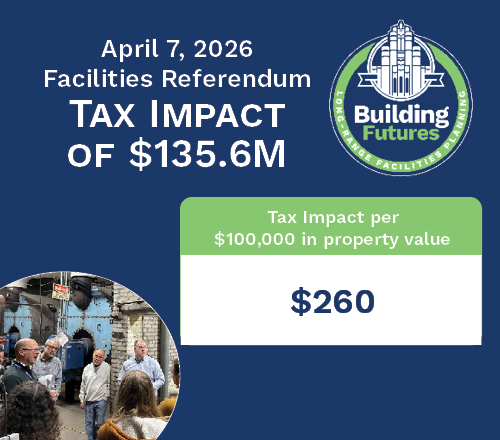
Preliminary tax impact estimates assume borrowing over a 21-year period at an interest rate of 5% to 5.25%. The District is scheduled to pay off the remaining debt obligations from the November 2009 referendum in 2026 and the impact of those final payments is included in these estimates. The current tax levy impact of the November 2009 referendum debt is $57 per $100,000 of property value.
Source: PTMA Financial Solutions

The referendum question focuses on facilities across the district.
Attend an upcoming presentation to learn more about the needs of buildings across the district and proposed projects that would be paid for by the referendum.
Information Sessions
The School Board invites the community to attend an upcoming presentation about the facilities referendum. Presentation dates, times, and locations are included below. The same information will be shared during each presentation. Building tours and questions & answers will differ by session and will not be recorded.
Click here to view the presentation slides.
Click here to view a recording of the February 24 Information Session at Cumberland.
Click here to view the one page Facilities Referendum Informational flyer.
Click here to view the building renovation categories.
|
Monday, February 2 at Richards Great Hall
6:00 pm Building Tour
7:00 pm Presentation & Question and Answer Session
Thursday, February 19 at Lydell School & Community Center Gym
1:30 pm Building Tour
2:00 pm Presentation & Question and Answer Session
Wednesday, March 4 at WFB Middle School Gym
6:00 pm Building Tour
7:00 pm Presentation & Question and Answer Session
Tuesday, February 17 at WFB High School Link
6:00 pm Building Tour
7:00 pm Presentation & Question and Answer Session
Tuesday, February 24 at the Cumberland Great Room
6:00 pm Building Tour
7:00 pm Presentation & Question and Answer Session
Monday, April 6 at WFB Middle School Gym
6:00 pm Building Tour
7:00 pm Presentation & Question and Answer Session
|
Childcare is available for elementary-aged children during the presentations. Click here to register for childcare.
Proposed Projects:
The projects listed below would be completed, should the referendum pass on April 7.
Renovations at Cumberland, Richards, High School, and Lydell ($67.9 million)
Focus Areas: Aging Infrastructure, Accessibility, Safety & Security
- Increase - Accessibility, safety, and security at building entrances
- Improve - Elementary drop off and pick up
- Upgrade - Fire and sprinkler systems to code
- Update - Plumbing and electrical systems
- Replace - Aging and unreliable HVAC systems
Construct New Middle School ($67.7 million)
Focus Areas: Learning Environments, Aging Infrastructure, Accessibility, Safety & Security
- Flexible Learning Spaces - Designed to align with teaching best practices
- Honor the Past - Veterans Memorial integrated into the overall project plan
- Minimal Disruption to Learning - During construction of a new building
Total Proposed Referendum Cost: $135.6 million
|
|
|
|
|
Key Documents:
The Board, District, and Facilities Advisory Committee (FAC) are excited to share their work and how the District has arrived at this point in the process. If you only have a short amount of time to learn about the facilities planning process, please review the key documents below by clicking on each button. If you have a bit more time, we encourage you to take a deep dive into all of the resources linked on this page. Please reach out to a committee member if you have any questions that come up. Thank you for your engagement!
If you have a question that hasn't been addressed in the FAQ section, please submit your question by clicking on the button below.

|
In-Depth Learning Topics:
|
Facilities Presentations & Progress Updates (Click to Expand)
- September 16, 2025: Referendum Planning Discussion
- August 13, 2025: Facilities Advisory Committee Progress Update
- July 9, 2025: Facilities Advisory Committee Progress Update
- June 11, 2025: Facilities Advisory Committee Progress Update
- May 14, 2025: Facilities Advisory Committee Progress Update
- April 30: Facilities Advisory Committee Progress Update
- March 18, 2025: Facilities Advisory Committee Progress Update
- February 26, 2025: Facilities Advisory Committee Progress Update
- January 29, 2025: Facilities Advisory Committee Progress Update
- August 7, 2024: Process Review & Next Steps
- November 1, 2023: Community Presentation at WFBHS
- October 18, 2023: Community Presentation at WFBMS
- September 27, 2023: Existing Facilities Conditions
- August 9, 2023: Long Range Planning Process, Steps 1 & 2
- June 14, 2023: Kick Off Presentation
Facilities Advisory Committee Learning Topics (Click to Expand)
|
Frequently Asked Questions: Facilities Process
|
What is Whitefish Bay School District’s Facilities Long-Range Planning process? (An Overview)
Whitefish Bay School District’s facilities long range planning effort was developed through collaboration between the School Board, district leaders, and our community. This work builds on our District Focus Plan and reflects our shared commitment to supporting student learning, strong governance, and responsible stewardship of resources.
The purpose of the facilities long range planning process is to look ahead over the next 20 years to ensure that our schools remain safe, sustainable, and well-suited to the evolving needs of students, staff, and the community. This includes addressing ongoing maintenance, planning for future enrollment, and aligning our facilities with the high expectations our community holds for educational excellence.
Through this process, we will bring forward recommendations and seek input from families, staff, and community members. The feedback gathered from the community survey will help us determine the best path forward so that our facilities continue to support the exceptional teaching and learning that define the Whitefish Bay School District.
What has been learned through this process and from facilities and long-range planning?
The Facilities Advisory Committee (FAC) is a group of nearly twenty school community members, including family members, recreation participants, staff, and students. The committee spent 8 months meeting and learning about District needs related to facilities plan development with the goal of providing a recommended plan to the Board of Education.
Click here to review presentations and learning topics.
What needs did the facilities planning process identify?
The Facilities Charter outlined four priority areas for the facilities planning process, which were the focus of the FAC. The priority areas are as follows:
- Learning Spaces: Ensuring classrooms support modern teaching methods and collaboration.
- Infrastructure: Addressing aging systems like plumbing, HVAC, and electrical.
- Health, Safety & Security: Creating secure, accessible, and safe environments for everyone.
- Sustainability: Improving energy efficiency to reduce long-term costs and environmental impact.
The committee's in-depth review, including tours and a comprehensive facility assessment, has helped to determine the full scope of needs and priorities.
What other options were considered for updating the Middle School?
Due to the landlocked nature of Whitefish Bay, there are limited options for updating District buildings. Most potential options involved updating buildings on their current sites, with the possibility for increasing square footage with additions. Still, space available for expansion is very limited and would reduce outdoor areas for playgrounds, athletic fields, and parking.
Based on the challenges presented with the current Middle School, several options for remodeling or relocating the building were considered, including:
- New Middle School on the Lydell site (too small of a footprint, loss of shared amenities with the High School, transportation challenges)
- New Middle School on Armory (Lacrosse) Field (cannot replace field elsewhere; largest greenspace available)
- New Middle School attached to the High School (traffic, parking, and logistical issues; challenges in relocating softball field)
- New Middle School bridging over Henry Clay Street (height of bridge needed for traffic is impractical)
- New Middle School built over Henry Clay Street by closing the street (re-routing traffic would create challenges)
- Rebuild the Middle School in its current location (multi-year disruption to teaching and learning; limitations of remodeling or rebuilding on current site)
For the reasons included above, the board decided against pursuing the listed options at this time.
What is the enrollment outlook for the District?
After a drop in enrollment during the COVID-19 pandemic, enrollment has stabilized and actually increased each of the last two years (2024-25 and 2025-26) by roughly 30 students each year. The current number of students enrolled in the Whitefish Bay School District is 2,871.
In order to determine long-term projections, the District worked with consultant MD Roffers to facilitate an enrollment study, which was completed in Spring 2025. The results of the study were shared at a May 28, 2025 board meeting. The study showed enrollment staying relatively flat, with a decrease of 128 students across all district schools by 2040. The study anticipated an increase in students at Cumberland with a decrease at Richards, the Middle School and the High School.
I was not able to make it to a Community Presentation. What information was shared and where can I access it?
The District hosted community facilities presentations which began in November 2023. Below you will find the presentations from the previous community presentations
The District held referendum information sessions about the referendum between February and April, 2026. Below, you will find resources related to information sessions.
|
Frequently Asked Questions: Wisconsin School Finance
|
How much of a resident's taxes goes toward funding the school district?
For a resident in Whitefish Bay, there will be multiple entities that are part of a tax bill each year. Typically, the largest portions of a resident’s tax bill will go to Milwaukee County, the Village of Whitefish Bay, and the Whitefish Bay School District. The portion for each entity will vary from year-to-year based on how each organization sets their levy for that year. On average, the portion of a resident’s tax bill that will go towards the Whitefish Bay School District will be roughly one-third of their total tax bill. However, this will vary based on the year and local factors such as property valuation and tax credits from the state.
Another important aspect of the taxes for the Whitefish Bay School District is that a portion of that amount will go to the private school voucher program rather than to the District. The private school voucher program is currently structured to have local public school districts levy on behalf of the program and then send the money back to the state for distribution.
How is the property tax amount calculated?
A homeowner’s property valuation will be the primary factor when determining the tax amount listed on the tax bill each year. In order to determine the exact amount, the total estimated fair market value will be multiplied by the tax levy rate from the school district and will then be reduced by the school levy tax credit from the state.
For more information on how the tax amount is calculated, please review slide #23 from this presentation that was given to the Facilities Advisory Committee (FAC) in March 2025.
Why hasn’t the District saved up money to complete these projects?
Whitefish Bay School District, along with all other public school districts in Wisconsin, work within revenue caps, or revenue limits, that restrict how much revenue a district is able to collect each year through state aid and the tax levy. Within these revenue limits, a school district must balance expenses for staff compensation, employee benefits, utilities, insurance, building maintenance, and other services to keep the school year going. Unfortunately, there is no specific source of funding from the state for capital improvements and so school districts must manage these building costs within their regular operational budget. With state funding lagging behind inflation for the last 15 years, by the time districts are able to address the rising costs for day-to-day operations, there is very little funding available to address larger capital items.
Despite these challenges, Whitefish Bay has done its best to address some of these critical infrastructure needs over the years. Through careful planning, the District has been able to extend the maximum life expectancy of some of these systems and commit funds to critical items that needed to be addressed. However, to fully address these needs, the District would need to exceed the revenue limit through a referendum in order to obtain the necessary funding to complete these projects.
For more information on public school finance in Wisconsin, please review this presentation that was given to the Facilities Advisory Committee (FAC) in March 2025.
What is the revenue limit and how is the District maintaining facilities?
Watch this short video for an overview:
What is the Whitefish Bay School District's current credit rating, how does it compare statewide, and what impact does this rating have on future funding decisions?
The Whitefish Bay School District has one of the highest credit ratings in the state, Aa1 from Moody’s. This rating places Whitefish Bay among the top public schools in Wisconsin in terms of credit rating and there are currently only three (3) public school districts that have a higher credit rating than Whitefish Bay with a Moody’s rating of Aaa. In order for Whitefish Bay School District to obtain the highest credit rating, there would need to be a much larger development of commercial and industrial properties.
The difference in interest rate that an organization could receive between a Aaa rating and a Aa1 rating is minimal. With a strong credit rating of Aa1 from Moody’s, the Whitefish Bay School District would be an ideal position to secure a competitive interest rate if a referendum was approved by the community.
Public school districts in Wisconsin will receive a credit rating from one of two agencies, Moody’s or S&P Global. Each agency has their own rating scale and the factors that determine a rating include resident income, property values, enrollment trends, available fund balance, net cash ratio, the state funding system, long-term liabilities ratio, and fixed-costs ratio. Some of these areas a school district has control over and some are determined based on local demographics or state programs.
|
Frequently Asked Questions: Buildings
|
Why not remodel the Middle School on its current site or another location?
Remodeling the current Middle School would have limitations due to the current building structure and layout, such as an inability to move loadbearing walls. The cost to remodel the Middle School was estimated to be $67.8M. Rebuilding a new Middle School on the current tennis courts and Armory Memorial would allow for more flexibility in design at a cost of $67.7M. Other locations were also considered for a new Middle School, but due to the landlocked nature of Whitefish Bay with minimal green space or space for development, a suitable site could not be identified. More information on options that were considered can be found on slides 11-29 of the linked document.
How was the projected cost for the new Middle School (e.g., the $67 million figure) determined without a final design, and what is the detailed rationale for building new versus renovating the existing facility?
The $67 million is a preliminary cost projection based on standard industry models adjusted for inflation and the required square footage for a modern middle school tailored for Whitefish Bay’s curriculum and activities, as the final design is currently not complete and the project is still awaiting community support. This initial estimate is crucial for planning but would be further refined if the project moves forward. The rationale for building new versus renovating is based on long-term fiscal responsibility: new construction offers a 50+ year lifespan, lower life-cycle costs from modern, efficient systems, and the ability to create optimal educational spaces, which old facilities often cannot structurally or economically accommodate. Renovating an older building can be as expensive with higher risks of hidden costs, code issues, and significant disruption and displacement of student learning.
Are playgrounds included in this project?
Currently, both Cumberland and Richards school communities are raising funds to update playground equipment at each location. As a result, playground updates are not included as potential facilities updates.
What other options were considered for updating buildings?
Due to the landlocked nature of Whitefish Bay, there are limited options for updating District buildings. Most potential options involved updating buildings on their current sites, with the possibility for increasing square footage with additions. Still, space available for expansion is very limited and would reduce outdoor areas for playgrounds, athletic fields, and parking.
How will traffic patterns be improved by the new Middle School location?
The design of a new middle school includes a pull-off lane in front of the school, which will improve traffic flow and safety compared to the current setup. Right now, vehicles stopping directly on Henry Clay and surrounding streets to drop off or pick up students create backups, unsafe passing, and conflicts with pedestrians and cyclists. The new design provides a dedicated pull-off area where vehicles can stop safely without obstructing through traffic. The separation of moving and stopping vehicles will reduce congestion, improve sightlines for drivers and walkers, and create a safer, more predictable environment for drivers, bikers, and pedestrians.
|
|
|
If you have a question that hasn't been addressed in the FAQs above, please submit your question by clicking on the button below.
|
How We Got Here: Key Players & Opportunities to Provide Feedback
Members of the facilities planning process are eager to hear ideas and feedback from members of our community. There are several opportunities to share ideas throughout the planning process, either by contacting committee members individually, by participating in a Focus Group (week of February 24, 2025), by participating in a World Cafe Conversation (May 22, 2025), by attending a community presentation (November 10 - 18, 2025), or by sharing your input as part of a community survey (survey window closes on November 20, 2025).
Feedback has been, and continues to be gathered from various stakeholders. The information has been compiled and themes were identified. Please review the Facilities Options Development: Summative Report for more information and an overview of themes.
Expand the headings below to learn more about ways that feedback has been gathered, and for information on sharing your feedback moving forward.
|
This subcommittee was created by the Board to assist in guiding the facilities planning process. Subcommittee members include Board Members Sandy Saltzstein and Nathan Christenson, Superintendent Dr. Jamie Foeckler, Director of Business Services Ben Irwin, Director of Buildings & Grounds Brian Chase, Facilities Advisory Committee Co-Chairs, as well as representatives from Plunkett Raysich Architects and CD Smith. Meetings of the Facilities Subcommittee will be included on the calendar below, as well as in BoardDocs, two days prior to the meeting date.
Facilities Advisory Committee
The Facilities Advisory Committee, chaired by community members Nahid Afsari and Nicole Miskel, includes nearly twenty school community members, including family members, recreation participants, staff, and students. The committee will learn about District needs related to facilities plan development with the goal of providing a recommended plan to the Board of Education. Meetings of the Facilities Advisory Committee will be included on the calendar below, as well as in BoardDocs, two days prior to the meeting date. Click here for a list of all committee members.
The focus group work conducted by the Whitefish Bay School District Facilities Advisory Committee in February 2025 gathered valuable insights from a diverse group of stakeholders, including students, staff, and community members. The purpose of focus group discussions was to better understand the strengths and challenges of current facilities and to identify opportunities for improvement in alignment with the District’s long-term goals emerging from the Facilities Charter.
Review the themes that were gleaned from the Focus Groups in the Summative Report.
Community presentations will occur primarily during School Board Meetings. The presentations provide an opportunity to stay updated and hear directly from the District and Facilities Advisory Committee Co-Chairs about the status of the facilities plan development. All school board meetings, with agendas, will be posted in BoardDocs, two days prior to the meeting date. If you would like to receive email notices of upcoming School Board meetings, please complete the linked form.
A Message from the School Board, January 8, 2026
Greetings Whitefish Bay Community,
On January 7, the School Board held a committee meeting, in accordance with Wisconsin Open Meetings Law, to review the Facilities Survey results and discuss the possibility of a referendum question for the April 7, 2026 ballot.
We invite you to join us for our upcoming meetings on Wednesday, January 14 and Thursday, January 22, at 7:00 PM in the High School Library Media Center.
Meeting Schedule & Public Comment:
- Wednesday, January 14 in the High School Library Media Center
- 7:00 PM: Regular Business Meeting
- Public Comment: An opportunity is provided toward the end of this meeting for comments on any topic.
- Immediately Following the Regular Business Meeting: Committee of the Whole Meeting
- Public Comment: An opportunity is provided toward the end of this meeting for comments specifically regarding agenda items, which includes the discussion of the possible referendum question.
- Thursday, January 22 in the High School Library Media Center
- 7:00 PM: Regular Business Meeting
- Public Comment: An opportunity is provided both toward the beginning of this meeting specifically regarding agenda items, which includes the discussion of the possible referendum question, as well as toward the end of this meeting for comments on any topic.
We value your engagement and look forward to hearing your perspectives. Should you have questions, you are always welcome to contact the School District at districtnews@wfbschools.com or submit a question using the link provided.
Yours in Education,
Kristin Bencik-Boudreau, Board President, Lynn Raines, Board Vice-President & Clerk, W. Brett Christiansen, Board Treasurer, Nathan Christenson, Board Member, Sandy Saltzstein, Board Member, Dan Tyk, Board Member, and Pam Woodard, Board Member
Board meetings are also live streamed. Links to the live stream can be found in meeting postings in BoardDocs.
_____________________________________
Previous Presentations
The Whitefish Bay School District held several community presentations about our long range facilities planning process. Past presentations are listed below. The District anticipates planning additional presentations moving forward.
Facilities Survey Presentations: Community presentations were held at each district building, prior to the survey deadline of November 20. The same information was shared at each session.
- Monday, November 10 at 6:00 - 6:45 pm in the Richards Great Hall
- Tuesday, November 11 at 6:00 - 6:45 pm in the Middle School Gym
- Thursday, November 13 at 1:00 - 1:45 pm in Lydell School & Community Center Room 17
- Monday, November 17 at 6:00 - 6:45 pm in the High School Library Media Center
- Tuesday, November 18 at 6:00 - 6:45 pm in the Cumberland Great Room
If you would like to view a recording of the presentation, please click here.
If you would like to view the presentation slides, please click here.
If you would like to view a video from Superintendent Foeckler about the survey, please click here.
We look forward to partnering with the community as we plan for the future of the Whitefish Bay School District.
Facilities Survey Results: The results of the Facilities Survey were presented to the community at the December 10, 2025 School Board Meeting.
If you would like to view the facilities survey report, please click here.
If you would like to view an additional analysis of the facilities survey results, please click here.
If you would like to view a recording of the December 10, 2025 School Board Meeting, please click here.
World Cafe Conversations are structured, small group discussions that encourage collaborative dialogue and idea sharing around facilities planning in a relaxed setting. The Faciliites Advisory Committee hosted the conversation on May 22 from 6:00 - 7:30 pm in the Richards Great Hall.
Thank you to all those who shared their input by taking the Facilities Survey!
The window to complete the survey was November 1 through November 20. Community presentations were held at each district building, prior to the survey deadline. The same information was shared at each session.
Survey results were shared at the December 10th School Board Meeting. View the Survey Results presentations below.
Funding Development Timeline
The School Board shared the following information regarding the funding development timeline. See details below.
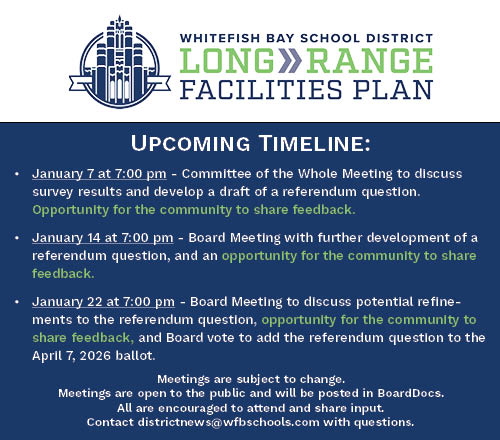
Save the Dates! The School Board for the School District of Whitefish Bay invites you to attend meetings to share feedback on a potential referendum question.
⏰ Wednesday, January 7 at 7:00 pm in the High School Library Media Center – Committee of the Whole Meeting to discuss survey results and develop a draft of a referendum question. Opportunity for community to share feedback.
⏰ Wednesday, January 14 at 7:00 pm in the High School Library Media Center – Board meeting with further development of a referendum question, and an opportunity for community to share feedback.
⏰ Thursday, January 22 at 7:00 pm in the High School Library Media Center – Board meeting to discuss potential refinements to the referendum question, opportunity for community to share feedback, and Board vote to add the referendum question to the April 7, 2026 ballot.
Meetings are subject to change. Meetings are open to the public and will be posted in BoardDocs. All are encouraged to attend and share input. Contact districtnews@wfbschools.com with questions.
|
|
|
|
|
Photo Gallery
Click on the thumbnail to enlarge photos.
|
|
|
|
|